
Is LASIK Surgery Safe? Expert Answers From An Ophthalmologist
Table of Contents
Most patients who come to me for LASIK have one question at the top of their mind:
“Is LASIK surgery safe?”
And I understand why.
You’ve probably already searched this online. You’ve read a few articles, maybe watched some videos, and possibly even come across mixed experiences. Some say it’s life-changing. Others say, “I wish I had waited.”
That leaves you somewhere in between.
We all live in a digital age where information is everywhere. But when it comes to your eyes, too much scattered information can actually make the decision harder.
So let’s simplify this.
So, is LASIK surgery safe?
The honest answer is:
Yes, LASIK is generally safe.
But it is not equally safe for everyone.
This is where most people get misled.
Safety does not depend only on the machine or the procedure.
It depends a lot on who is undergoing it.
What most people assume (and where it goes wrong)
Many patients walk in with these beliefs:
- “If it’s common, it must be completely safe.”
- “If I’m eligible, I’ll get perfect vision.”
- “Side effects are minor and temporary.”
These are not entirely wrong. But they are incomplete.
LASIK works very well when the eye is ideal for it.
Problems usually start when someone falls into a borderline category and still goes ahead.
I know what you’re actually worried about
You may not say it directly, but these are the real concerns I hear:
- “What if I end up worse than before?”
- “Can LASIK damage my vision permanently?”
- “Is there a chance I’ll regret this later?”
Let’s address these one by one.
1. Risk of serious damage or vision loss
This is the biggest fear.
In reality, serious complications are very rare.
LASIK has been performed for many years now, and overall safety is well established.
But rare does not mean impossible.
That is why proper screening is critical.
A well-selected patient has a very low risk. A poorly selected one carries unnecessary risk.
2. Dryness after LASIK
Almost everyone experiences some dryness initially.
For most people:
- It settles within a few weeks to months
- It is manageable with drops
But in some cases, it can last longer.
If you already have dry eyes before surgery, this becomes more relevant.
This is something I evaluate carefully before advising LASIK.
3. Night vision issues (halos and glare)
This is something patients often discover only after reading online.
You might notice:
- Halos around lights
- Glare while driving at night
In most cases, this improves over time.
But if your lifestyle involves frequent night driving, this is an important discussion to have before surgery.
4. Will the power come back?
LASIK reduces your number, but it does not stop natural changes in the eye.
So yes, in some patients:
- A small number can return over time
- Glasses may be needed again, though usually much lighter
This is more likely if:
- Your number was high
- Your vision was not fully stable before surgery
5. Late problems (less talked about)
Some issues don’t appear immediately.
For example, gradual weakening of the cornea is a known but uncommon complication.
Again, this links back to one thing: proper case selection.
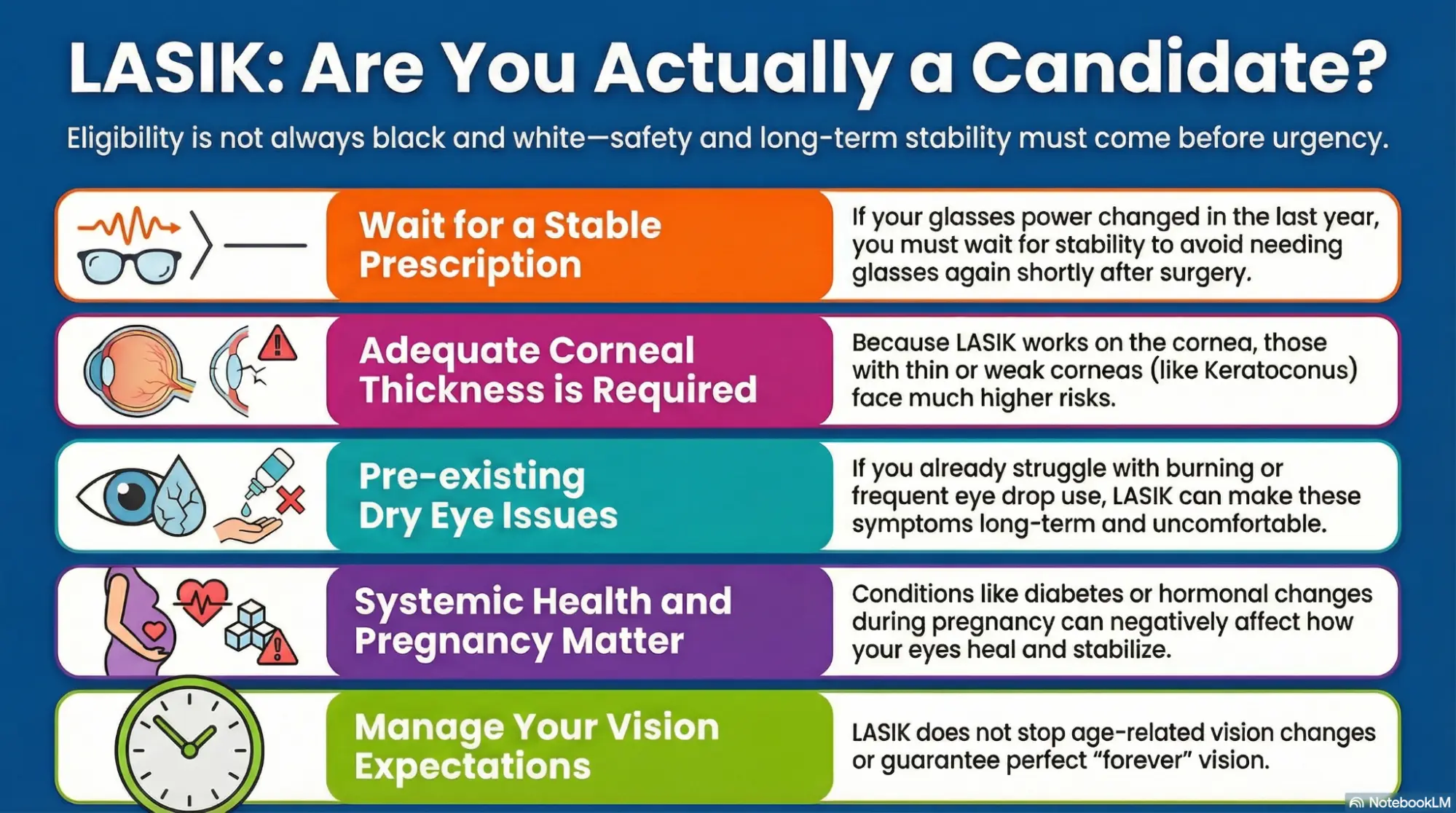
Who should be more cautious?
I usually ask patients to think carefully if:
- Your number is still changing
- Your cornea is on the thinner side
- You already struggle with dryness
- You have been told you are “borderline”
Eligibility is not always black and white.
There are grey zones, and that’s where judgment matters.
What patients often underestimate
Let me be very clear here.
- LASIK is permanent
- Recovery is quick, but not “perfect overnight” for everyone
- You may need to use lubricating drops for some time
- The result is often very good, but not always “perfect”
Most patients are happy.
But the happiest patients are the ones who had realistic expectations before surgery.
So how should you make this decision?
Instead of asking only “Is LASIK safe?” ask yourself:
- Is my eye a strong candidate or a borderline one?
- Am I okay with small trade-offs for convenience?
- Do I understand that results can vary slightly?
Take your time with this decision.
Final thought
LASIK is a reliable and widely performed procedure.
But the goal is not just to do LASIK.
The goal is to do it on the right eye, at the right time, for the right reasons.
If that alignment is correct, safety follows naturally.
If you’re unsure, don’t rush.
Clarity is more important than speed when it comes to your eyes.
To find out if you are an ideal candidate, schedule a comprehensive evaluation with the specialists at Clarity Eye Care today.