
Dear Parents,
Let me start by saying this clearly.
I am not anti-technology.
I use screens. You use screens. Our children are growing up in a digital world.
But the effect of long screen time on children’s eyes is something most families are underestimating.
And I say this after seeing hundreds of children in my clinic.
This is what many parents think.
Online classes. Homework. Coding. YouTube. Games.
You tell yourself, “It’s normal now.”
Then small things begin:
You assume it’s tiredness.
But let me explain what is actually happening inside the eye.
When a child stares at a phone or tablet for long hours:
This leads to headaches after screen use, a burning sensation, watery eyes, and blurred vision.
Normally, we blink 15 to 18 times per minute.
On a screen, blinking can drop significantly.
Less blinking means more dryness.
Dryness leads to irritation.
I see many children who don’t say, “My eyes feel dry.”
They simply say, “I get headaches every evening.”
That is digital eye strain.
But here is where most parents stop worrying.
They think strain is temporary.
Sometimes it is.
But when this stress persists daily for months and years during key growth years, the eye may begin to adapt in ways that increase the risk of myopia progression.
Let us talk about progressive myopia.
Many parents say to me:
“Doctor, even if my child gets glasses, what’s the problem? I wear specs too.”
Fair question. But here is the difference.
In children, myopia is not just about the number increasing.
In most cases, the eyeball becomes longer.
This process is called axial elongation.
The eye stretches from front to back.
And once it stretches, current treatments cannot shorten it back to its original length.
Glasses help your child see clearly. They do not reduce the length of the eye.
This is a structural change.
Imagine stretching a balloon. The wall becomes thinner. Similarly, an eye with high myopia can become structurally more vulnerable.
Research shows that higher levels of myopia are associated with increased lifetime risk of:
This does not mean every child with myopia will develop these conditions.
But the risk increases as myopia becomes higher.
This is why we take childhood myopia seriously.
It is not cosmetic.
It is structural.
And procedures like laser vision correction in adulthood reshape the front surface of the eye.
They do not change the axial length of the eyeball.
That is an important distinction.
Myopia has multiple causes.
Genetics plays a role.
The environment plays a role.
But prolonged near work, including excessive screen use, has been strongly associated with increased risk of developing and progressing myopia in children.
When children hold devices very close, sometimes less than 8 inches away, the eye constantly focuses at near distance.
Over time, this may stimulate signals that promote eye elongation.
The risk appears higher when:
No.
Reading is not the enemy.
Continuous near work without breaks is the issue.
Earlier, children naturally balanced work with outdoor play.
Today, many move from phone to tablet to laptop with very little visual rest.
The developing eye needs variation in focus.
It needs distance viewing.
It needs outdoor light.
Outdoor time is one of the simplest protective habits.
Bright outdoor light is much stronger than indoor lighting.
Research suggests that exposure to bright light may help regulate eye growth through biochemical pathways in the retina.
Children who spend more time outdoors have been shown to have a lower risk of developing myopia.
Most guidelines suggest aiming for around two hours of outdoor activity daily.
It does not need to be an intense sport.
Even regular outdoor play helps.
Let us focus on control, not fear. Ask your child to do the following things.
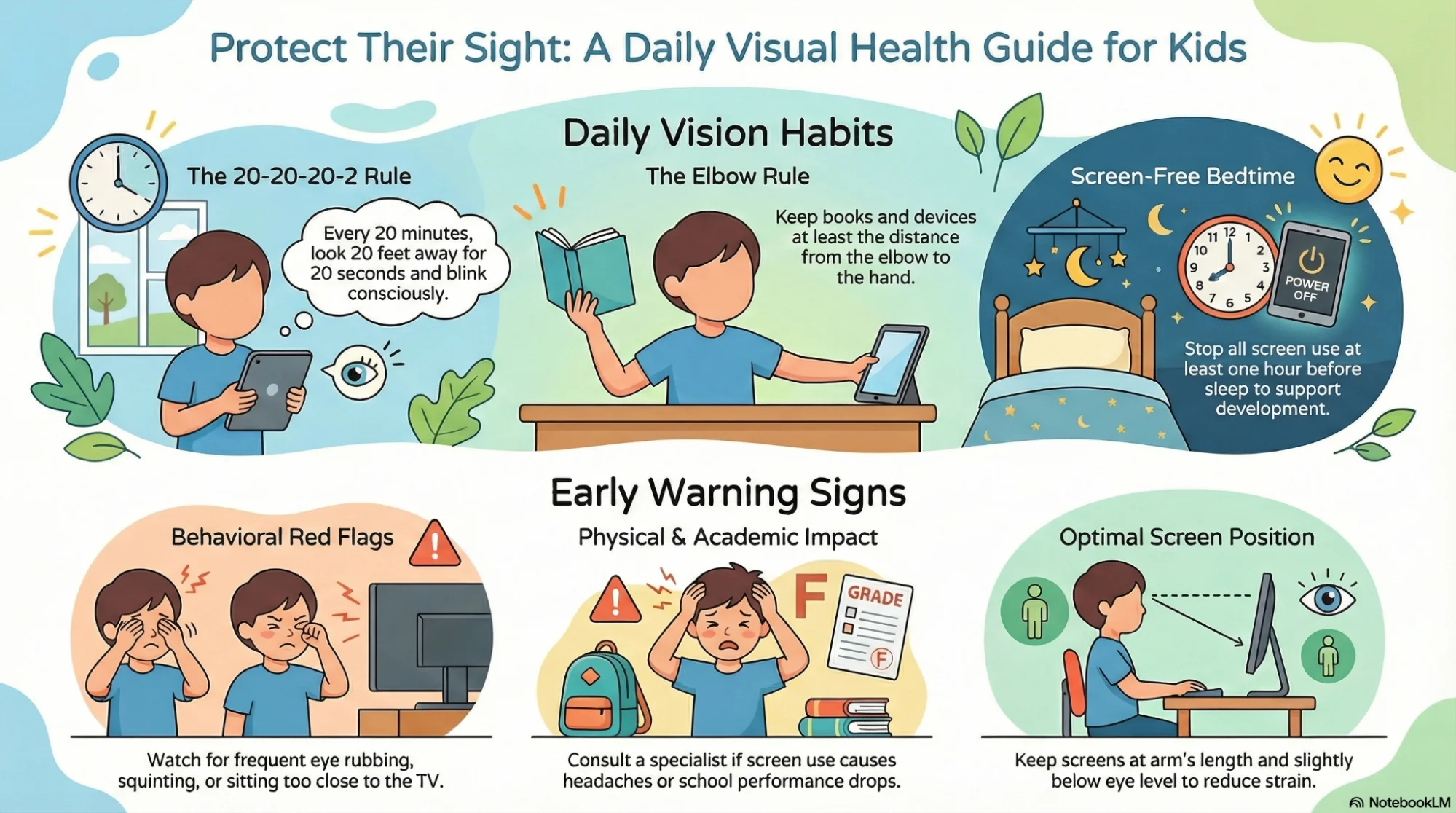
Every 20 minutes:
And aim for about 2 hours of outdoor time daily.
Devices and books should not be closer than the distance from the elbow to the hand.
If your child’s nose is almost touching the screen, that increases strain.
Computer screens should be:
This reduces dryness and strain.
Stop screens at least one hour before sleep.
Healthy sleep supports overall development, including visual health.
Consult an eye specialist if you notice:
Early detection gives us a better chance to slow the progression of myopia if it begins.
Do not panic.
We have treatments that may slow progression:
These treatments aim to slow further axial elongation.
They cannot reverse existing structural change.
That is why early intervention matters.
If you are thinking:
“Maybe I am overreacting.”
You are not.
If you are thinking:
“My child will adjust.”
Maybe.
But the developing eye also adapts to its environment.
The effect of long screen time on children’s eyes is not immediate blindness.
It is a gradual structural change in some children.
It builds quietly.
And it is influenced by daily habits.
Technology is part of modern life.
But unregulated screen exposure during childhood increases visual stress and may increase long-term risk.
As parents, you cannot remove screens completely.
But you can:
Childhood eye growth is happening right now.
And what we guide today can influence vision health for decades.
That is why this conversation matters.
The information in this article is based on peer-reviewed research and international ophthalmology guidelines, including studies published in journals such as Ophthalmology, JAMA, The Lancet Digital Health, and guidance from the American Academy of Ophthalmology.
If you have concerns about your child’s vision, a comprehensive eye examination is the most reliable next step.
Early awareness is not panic.
It is prevention.