
Which Lens is Best for Cataract Surgery? A Clear, Honest Guide by Dr. Nitesh Bhalla

Medically reviewed by Dr. Nitesh Bhalla
MBBS, M.S. in Ophthalmology | 11+ years of Experience
Table of Contents
Quick Summary: Matching Lenses to Visual Goals
If you want a fast answer, here is how modern intraocular lenses align with common lifestyle needs:
- For maximum distance clarity and uncompromised night driving: Choose a Standard Aspheric Monofocal Lens. It focuses all light at one point, delivering crisp contrast and zero night glare or halos. You’ll need reading glasses for close-up tasks.
- For fixing astigmatism: Choose a Toric Intraocular Lens. It features custom optics that neutralise an oval-shaped cornea, sharpening your natural uncorrected distance vision.
- For computer work and intermediate vision: Choose an Extended Depth of Focus (EDOF) Lens. It creates a continuous visual range from far away to arm’s length (60 to 70 cm), perfect for desktop screens and dashboards, with minimal night glare.
- For total freedom from glasses across near, intermediate, and far vision: Choose a Trifocal or Multifocal Lens. These divide light across concentric diffractive rings so you can read books, work on laptops, and drive without glasses.
- For fine-tuning your prescription AFTER surgery: Choose a Light Adjustable Lens (LAL). Made from photosensitive silicone, this lens lets your doctor adjust your exact visual outcome with painless UV light treatments in clinic weeks after surgery.
Just last week, a 62-year-old retired teacher sat across from me at Clarity Eye Care in Wakad. He looked at our corneal topography maps and biometry scans, leaned back, and asked a question I hear almost every day:
“Doctor, everyone tells me cataract surgery is quick and routine. But looking at all these lens options, monofocal, multifocal, toric, EDOF, my head is spinning. How do I actually know which lens is best for cataract surgery? Seems like cataract surgery is easy, but choosing the lens is difficult.”
His reaction was completely natural. As an eye surgeon who has evaluated thousands of eyes, I always reassure my patients: the surgery itself is one of the safest outpatient procedures performed today, usually taking under 30 minutes under local numbing drops. However, selecting your intraocular lens (IOL) to replace your eye’s cloudy natural lens is a decision that stays with you for life.
There is no single “magic” lens for everyone. The best lens for cataract surgery is simply the one that aligns with your daily habits, night driving needs, ocular health profile, and budget.
In this guide, I will draw upon my clinical experience at Clarity Eye Care and established ophthalmic research to walk you through your choices with complete transparency.
What Happens During Cataract Surgery?
To understand how artificial lenses work, it helps to know what a cataract is.
Think of your eye as a camera. Behind your colored iris sits a naturally clear lens that focuses light onto your retina. As we age, natural proteins within this lens clump together. Over time, this transforms a clear window into a cloudy pane, like looking through a fogged-up windshield.
During cataract surgery, we make a tiny micro-incision, use gentle ultrasound energy to break up the clouded lens, and vacuum it away. In its place, we insert a permanent, clear artificial intraocular lens (IOL) inside your eye’s natural capsular bag.
Because this medical-grade acrylic or silicone implant never wears out, your lens choice determines your visual quality for decades.
The Role of Precision Biometry Before Cataract Surgery
Before choosing a lens model, my clinical team performs advanced optical biometry and corneal mapping.
Using non-contact laser biometers, we measure three key structural dimensions of your eye:
- Axial Length: The physical length of your eye from cornea to retina.
- Corneal Power (Keratometry): The curvature and steepness of your corneal surface.
- Anterior Chamber Depth: The spatial distance between your cornea and natural lens.
We feed these precise measurements into modern AI-driven and ray-tracing mathematical formulas to calculate the exact optical power needed for your replacement lens. This step prevents “refractive surprises” and ensures your chosen lens performs at its best.
Breaking Down the 5 Main Lens Options
Let’s examine the five primary lens categories, including their optical mechanics, advantages, and real-world trade-offs.
1. Monofocal Lenses (The Time-Tested Standard)
A monofocal lens is the most widely implanted intraocular lens worldwide. The word “mono” means one: this lens focuses all incoming light onto a single distance, usually far away.
- Visual Experience: You enjoy crisp distance vision for driving, walking outdoors, and watching television. However, you will need reading glasses for close work like reading books or typing on a phone.
- The Night Vision Advantage: Monofocal lenses deliver 100% of light to one focal point without scattering rays. This preserves maximum contrast sensitivity and eliminates night-time glare or halos around streetlights and headlights.
- Monovision Strategy: For patients who want to reduce reading glasses without diffractive optics, we can set your dominant eye for crisp distance vision and your non-dominant eye slightly short for near vision, a technique called monovision.
- Insurance Coverage: Standard monofocal lenses represent the baseline medical standard and are typically covered by basic health insurance plans.
2. Toric Lenses (Fixing Corneal Astigmatism)
Astigmatism occurs when your cornea is shaped irregularly, resembling an oval football rather than a round basketball. This scatters light rays, causing blurred vision at all distances.
- How They Work: A toric IOL features custom optical curves that neutralise your corneal astigmatism. During surgery, your surgeon aligns the lens precisely with your corneal axis.
- The Benefit: Instead of requiring thick prescription glasses after surgery, a toric lens restores sharp uncorrected distance clarity.
- Key Detail: You can combine toric optics with monofocal, EDOF, or multifocal lenses. If biometry confirms significant astigmatism, selecting a toric option is essential.
3. Extended Depth of Focus (EDOF) Lenses (Built for Screens)
EDOF lenses are designed for today’s screen-heavy lifestyle.
- How They Work: Rather than splitting light into separate points, an EDOF lens gently stretches the focal point into a continuous linear zone of vision.
- Visual Experience: EDOF lenses provide smooth vision from distance down to arm’s length (60 to 70 cm). Patients enjoy effortless clarity when viewing car dashboards, desktop monitors, cooking, and recognising faces without glasses. Light readers may still be needed for tiny print in dim light.
- Night Driving: EDOF technology produces far fewer halos and glare than traditional multifocals, making it a great choice for active adults who drive at night.
4. Trifocal and Multifocal Lenses (Maximum Freedom from Glasses)
Multifocal and trifocal lenses are designed for patients whose main goal is to live daily life without glasses.
- How They Work: These implants feature microscopic concentric diffractive rings across their surface. These rings divide incoming light into distinct focal points: distance, intermediate, and near.
- Visual Experience: Trifocal lenses provide a full spectrum of vision. Clinical studies show that over 80% to 90% of trifocal recipients achieve complete spectacle independence, reading, texting, and driving without glasses.
- The Trade-off: Dividing light means each focal point receives a portion of available light. In low light, this can cause mild loss of contrast sensitivity and subtle halos or starbursts around headlights at night. While most patients adapt naturally over time, frequent night drivers should weigh this trade-off carefully.
5. Light Adjustable Lenses (LAL) (Post-Surgical Precision)
Historically, surgeons calculated lens power before surgery and fixed it permanently. The Light Adjustable Lens (RxSight LAL) changed this paradigm completely.
- How It Works: Made from photosensitive silicone, the LAL allows post-operative refinement. After your eye heals from surgery (2 to 3 weeks post-op), you test your vision in daily life.
- In-Office Customisation: If minor nearsightedness or astigmatism remains, your doctor uses a soft, non-invasive UV light treatment in clinic to reshape the lens inside your eye. After 2 to 3 brief sessions match your exact visual preference, a final light treatment locks the power permanently.
- Best Candidates: LAL is ideal for patients who have had previous LASIK or PRK surgery, where historical corneal changes make pre-op calculations trickier.
A Surgeon's 5-Step Framework for Choosing Your Lens
At Clarity Eye Care, we guide you through a simple, 5-step medical decision framework:
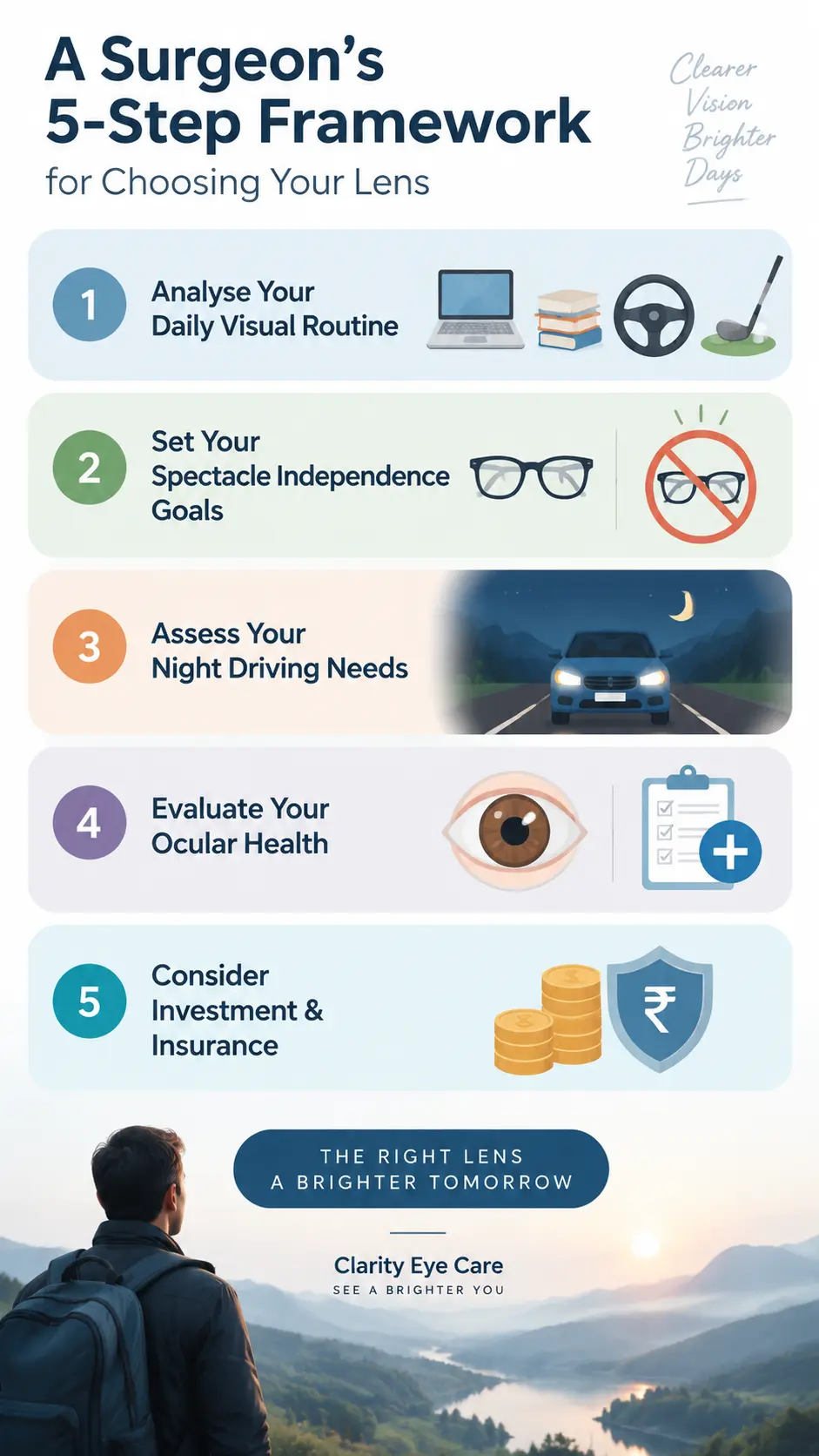
Step 1: Analyse Your Daily Visual Routine
Inventory how you spend your day. Do you read physical books, work on desktop screens, drive across town, or golf? Your primary activities dictate which visual zones matter most.
Step 2: Establish Your Spectacle Independence Goals
Be honest about reading glasses. If keeping readers handy for fine print does not bother you, a standard monofocal lens delivers phenomenal clarity. If you want to wake up, swim, and travel glasses-free, premium EDOF or trifocal lenses are worth considering.
Step 3: Assess Your Night Driving Needs
If you frequently drive on unlit highways at night, preserving peak contrast sensitivity is essential. Monofocal or EDOF lenses offer superior night-time clarity compared to diffractive multifocals.
Step 4: Evaluate Your Comprehensive Ocular Health
Your surgeon must inspect your retina, optic nerve, and cornea. Co-existing conditions like macular degeneration, glaucoma, or severe dry eye reduce contrast sensitivity. In these cases, a multifocal lens can split light and dim your vision. A monofocal or toric lens is medically safer and ensures bright light reaches your retina.
Step 5: Consider Financial Investment and Insurance
Standard monofocal lenses are typically covered by basic insurance. Premium options, such as toric, EDOF, trifocal, and Light Adjustable lenses, involve out-of-pocket costs. Choose an option that comfortably fits your budget.
Comparison Table
Lens Category | Primary Focus Range | Need for Reading Glasses | Night Driving Profile | Best Suited For |
Monofocal | Distance | Yes (for near/intermediate) | Crisp & Clear (Zero halos) | Maximum clarity, night drivers, budget-friendly |
Toric | Distance + Astigmatism | Yes (unless combined with premium optics) | Crisp & Clear | Anyone with corneal astigmatism |
EDOF | Distance to Intermediate | Minimal (readers for small print) | Very Good (Minimal glare) | Active professionals, screen users, casual night drivers |
Trifocal / Multifocal | Full Range (Far, Mid, Near) | Rarely needed (80 to 90% glasses-free) | Moderate (Possible subtle halos) | Complete freedom from glasses, daytime drivers |
Light Adjustable (LAL) | Custom fine-tuned focus | Minimal to None | Excellent | Post-LASIK patients, individuals seeking exact precision |
Common Patient Questions
Cataract surgery is virtually painless. Your surgical team applies localised numbing drops before the procedure begins. You may feel mild pressure, but no pain. Most patients notice visual improvements within 24 to 48 hours and resume normal daily activities right away.
No. Once your natural, cloudy lens is removed, a cataract can never return. However, months or years later, the natural membrane holding your new lens can haze. This condition, called Posterior Capsule Opacification (PCO), is cleared in clinic using a quick, 5-minute YAG laser procedure that requires no incision.
You can still undergo successful cataract surgery. Because prior LASIK reshapes your outer cornea, standard pre-op biometry calculations must be modified. Surgeons use specialised post-refractive formulas or post-operative options like the Light Adjustable Lens to ensure precision.
Not at all. Standard monofocal lenses are among the most successful implants in medicine. Millions of patients worldwide live happy, active lives with monofocal lenses, enjoying clear distance vision outdoors while keeping simple reading glasses nearby for books and phones.
Final Clinical Guidance from Dr. Nitesh Bhalla
Whenever a patient asks me, “Doctor, which lens is best for cataract surgery?”, my answer is always grounded in personalised care: The best lens is the one custom-matched to your eyes, your lifestyle habits, and your peace of mind.
You should never feel pressured into choosing the most expensive premium lens option. Standard monofocal lenses represent an outstanding achievement that restores clear sight. If freedom from glasses fits your active lifestyle and your eye health allows it, modern EDOF, trifocal, or light-adjustable technologies offer incredible visual freedom.
Take your time during your consultation. Discuss your daily routine, computer work, driving habits, and visual expectations with your eye surgeon. Together, you will select the ideal lens to restore your sight with complete clarity and confidence.
References & Reputable Sources
- American Academy of Ophthalmology (AAO): Intraocular Lenses (IOLs) for Cataract Surgery & Factors to Consider in Choosing an IOL. Clinical guidelines on monofocal, multifocal, toric, and presbyopia-correcting lens selection criteria.
- American Academy of Ophthalmology (AAO): Intraocular Lenses Guide: Detailed medical overview of artificial lens materials, optical powers, and surgical placement.
- National Eye Institute (NEI): Cataracts Overview: Federal public health guidance on cataract formation, symptoms, and surgical replacement.
- Mayo Clinic: Cataract Surgery & IOL Evaluation: Clinical guide covering pre-operative ultrasound measurements, surgical steps, and recovery benchmarks.
- NCBI Bookshelf / CADTH Health Technology Review: Systematic evidence review evaluating the clinical effectiveness and uncorrected visual acuity of toric vs. nontoric IOLs.
- EyeWiki (AAO): Biometry for IOL Power Calculation: Comprehensive ophthalmic reference on optical biometry, axial length, keratometry, and AI-driven IOL calculation formulas.
- Dove Medical Press: Clinical Ophthalmology Journal: Peer-reviewed academic review analysing spherical aberration profiles, optical defocus curves, and refractive target selection.
Clinic & Practice References
- Clarity Eye Care: Dr. Nitesh Bhalla’s Clinic: Official website for Dr. Nitesh Bhalla’s eye clinic in Wakad and Hinjewadi.
- Clarity Eye Care Blog: Why Cataract Surgery Is Simple, Lens Choice Isn’t: Dr. Bhalla’s clinical blog post on lens trade-offs and personalised patient counselling.
- London Cataract Centre: Best Lens for Night Driving Guide: Expert guide analysing contrast sensitivity, halos, and low-light performance across lens types.
- Dr. P. Siva Reddy Eye Hospital: Monofocal vs Premium Lens Guide: Comparative analysis of standard monofocal and premium EDOF/multifocal implants.
- Advanced Sight Center: Pros and Cons of Toric Lenses: Patient guide on correcting corneal astigmatism during cataract lens replacement.
About Dr. Nitesh Bhalla & Clarity Eye Care
Dr. Nitesh Bhalla (MBBS, MS Ophthalmology, Fellow in Comprehensive Ophthalmology & Glaucoma) is the founder and lead eye surgeon at Clarity Eye Care, serving patients across Wakad, Hinjewadi, and Pune. Clarity Eye Care is dedicated to patient-first, transparent eye care, combining modern diagnostic technology with honest medical advice.