
Why Do Eyes Twitch? (Explained by an Ophthalmologist)
Table of Contents
When I was a child, I remember my eyes twitching sometimes. Out of curiosity, I would ask my mother why it happens. She would smile and say it’s either good luck or bad luck.
Years later, as an ophthalmologist, I now know the real reason behind it. And no, it has nothing to do with luck. It’s also not something serious in most cases.
If your eye has been twitching and you’re wondering why do eyes twitch, stay with me. I’ll explain what’s actually happening and when you should pay attention.
First, What Exactly Is This Twitch?
What you’re noticing is usually eyelid myokymia.
That’s just a medical way of saying: small, repetitive muscle contractions in your eyelid.
Think of it like this.
Your eyelid muscles are like a phone on vibration mode. Normally silent. But when overstimulated, they start buzzing without your control.
That “buzz” is what you feel as twitching.
Why Do Eyes Twitch? (The Real Causes)
Most people assume one single cause. That’s usually wrong.
In reality, it’s a build-up of small stresses, not one big issue.
1. Sleep imbalance (not just sleep deprivation)
It’s not always about sleeping less.
It’s about irregular sleep.
Late nights, inconsistent sleep timing, poor-quality sleep.
Your nervous system becomes unstable. The eyelid is one of the first places it shows up.
2. Screen overload
You may think, “I use screens daily, why now?”
Because the effect is cumulative.
Long screen hours reduce blinking.
Your eyes stay strained longer than they should.
Over time, the muscles become irritable.
3. Caffeine overload
Coffee, tea, energy drinks.
Caffeine stimulates your nervous system.
In excess, it makes muscles more “trigger-happy.”
That’s when twitching starts.
4. Stress, but not in the way you think
Stress is often blamed. But it’s rarely the only cause.
Even if you feel relaxed, your body may still be under background stress from:
- Poor sleep
- Screen fatigue
- Work pressure buildup
So yes, stress plays a role. But it’s usually part of a larger pattern.
5. Eye dryness and strain
Dry eyes don’t always feel dry.
Instead, they can show up as:
- Twitching
- Mild irritation
- Heaviness
Your eyelid is trying to compensate.
How Long Is “Normal” for Eye Twitching?
This is where most people get anxious.
Here’s the truth:
- It can last a few hours to a few days
- Sometimes it comes and goes for weeks
That still doesn’t automatically mean something serious.
What matters is pattern, not just duration.
When Should You Actually Worry?
Let’s be clear and practical.
Usually NOT serious:
- Twitching only in the eyelid
- No pain
- No vision changes
- Comes and goes
- Worse with fatigue or caffeine
Needs medical attention:
- Twitch spreads to the cheek or face
- One side of the face feels weak
- Difficulty opening or closing the eye
- Drooping of the eyelid
- Vision problems
This is the real line you should watch.
Common Myths You Should Ignore
“It’s always a vitamin deficiency”
Not usually.
People start supplements randomly.
Most of the time, it doesn’t fix the problem.
“If it lasts days, it’s serious”
Incorrect.
Benign twitching can persist longer than expected.
“Reducing screen time fixes it instantly”
No.
There’s a lag.
Your body takes time to settle.
“It’s nerve damage”
Almost never.
True neurological issues look very different and come with other symptoms.
What You Can Actually Do to Reduce Eye Twitching
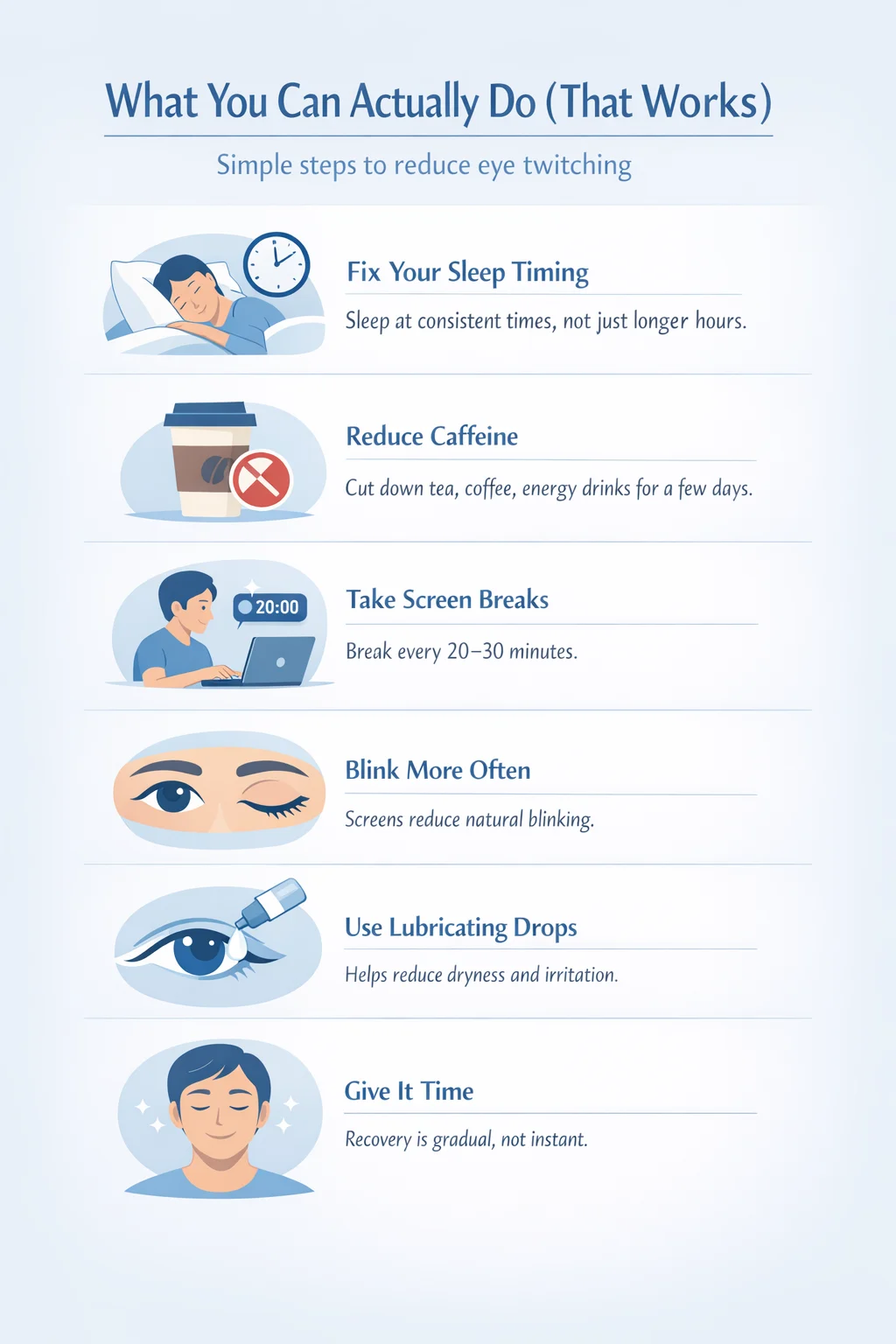
Don’t overcomplicate this.
Focus on these:
- Fix your sleep timing, not just duration
- Reduce caffeine for a few days
- Take screen breaks every 20–30 minutes
- Blink consciously when using screens
- Use lubricating eye drops if needed
And most importantly,
Give it time
Recovery is not immediate.
The Right Way to Think About It
Your eye is not the problem.
It’s the signal.
It’s showing you that your system is slightly overloaded.
Once you correct the inputs, the twitch settles.
Final Thought
I understand why this bothers you.
It feels small, but it’s persistent and unpredictable.
But in most cases, it’s your body asking for minor adjustments, not signalling disease.
Watch the pattern.
Make small corrections.
Know the red flags.
That’s how you stay in control of it.
However, if your symptoms persist or you experience any of the red flags mentioned above, scheduling a comprehensive evaluation at Clarity Eye Care can give you the peace of mind you need.